NiftyImages vs Hyperise vs Driphue: Comparing Email Image Personalization Platforms

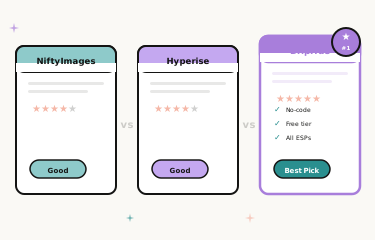
The Rise of Email Image Personalisation Tools
Email image personalisation has moved from a nice-to-have to a competitive necessity. As inbox competition intensifies, brands that deliver generic visual experiences are leaving engagement and revenue on the table. The market has responded with a growing number of specialised platforms, each taking a different approach to dynamic email imagery.
In this comparison, we examine three leading platforms — NiftyImages, Hyperise, and Driphue — to help you choose the right solution for your brand. We cover core features, design workflow, pricing models, integration ecosystems, ease of use, and the specific scenarios where each platform is the strongest choice. If you are new to this space, start with our complete guide to email image personalisation for e-commerce for foundational context.
NiftyImages: The Established Player
NiftyImages has been in the email image personalisation space for several years, building a solid reputation among experienced email marketers. The platform offers a mature range of dynamic image capabilities including personalised images with merge tags, dynamic maps, social proof widgets, and rule-based image display.
Strengths
NiftyImages has strong ESP integration support and a proven feature set at scale. The platform handles high-volume rendering reliably, and email marketers with technical experience will find the interface familiar. The rule-based image display system — showing different images to different subscribers based on conditions — is one of the platform’s more distinctive capabilities.
Considerations
The learning curve can be steep for teams without dedicated email development resources. The template design tools reflect the platform’s age and feel dated compared to newer tools built around modern design workflows. Pricing scales quickly at higher volumes. NiftyImages is powerful but may be more complex than growing brands need if they are primarily looking for name personalisation in hero images.
Best for
Enterprise email teams with technical resources who need advanced rule-based dynamic imagery and are comfortable with a more developer-oriented workflow. For a focused comparison between NiftyImages and Driphue specifically, see our NiftyImages alternative guide.
Hyperise: The Multi-Channel Personalisation Platform
Hyperise positions itself as a broad personalisation platform extending beyond email to websites, ads, and outbound sales channels. Email image personalisation is one component of a wider multi-channel system that also includes personalised video thumbnails, CRM data integration, website visitor personalisation, and LinkedIn outreach.
Strengths
Hyperise is the strongest choice for teams that genuinely need personalisation across multiple channels in a single platform. The multi-channel approach has clear value for B2B companies running account-based marketing campaigns where the same personalised assets need to appear in email, on landing pages, and in LinkedIn outreach simultaneously. The platform’s CRM integration depth is also distinctive.
Considerations
The multi-channel focus means email-specific features are less deep than dedicated email image platforms. Pricing reflects the broader feature scope, which can be more than e-commerce brands need if they primarily want email image personalisation. Teams that only need email personalisation will be paying for website and video features they will not use. The interface can be complex, particularly for first-time data connection setup. Hyperise also uses a proprietary design editor — there is no Canva import, so teams that design in Canva must maintain a parallel design workflow.
Best for
Multi-channel B2B marketing teams and sales organisations that need personalisation across email, website, and outbound channels in a single platform. For a focused comparison, see our Hyperise vs Driphue comparison and our Hyperise alternative guide.
Driphue: Purpose-Built for E-Commerce Email
Driphue is built specifically for e-commerce email image personalisation. The platform addresses the specific pain points that DTC and retail brands experience with dynamic imagery: design workflow friction, complex setup, and tools that were not built with e-commerce campaign types in mind.
Strengths
Driphue’s most distinctive advantage is its Canva-native workflow. You design personalised email images in Canva using your existing brand design system — fonts, colours, imagery, layout — and import directly into Driphue via the Canva integration. There is no proprietary editor to learn, no parallel design system to maintain. For the majority of e-commerce marketing teams already working in Canva, this makes personalised image creation a natural extension of the existing design workflow rather than a separate technical project.
Beyond the Canva workflow, Driphue provides deep, documented integration guides for every major e-commerce ESP with platform-specific merge tag syntax. Setup guides cover Klaviyo, Mailchimp, Omnisend, ActiveCampaign, HubSpot, GetResponse, ConvertKit, AWeber, and more. Driphue also provides purpose-built documentation for core e-commerce email flows: welcome series, cart abandonment, post-purchase sequences, and promotional campaigns.
Pricing is transparent and based on image views — you pay for what you use, with no unused channel features bundled in. Most e-commerce brands find Driphue significantly more cost-effective than multi-channel alternatives at equivalent personalisation volume.
Considerations
As the newest platform in this comparison, Driphue is still expanding its feature set. Some advanced enterprise capabilities available in more established platforms — rule-based image display, native inventory data feeds — are on the product roadmap but not yet available. Teams with complex conditional image logic requirements may find NiftyImages’s rule engine more suited to their current needs. Driphue does not offer website or video personalisation, so brands that need multi-channel coverage will need Hyperise or a separate tool.
Best for
E-commerce and DTC brands focused on email marketing revenue, teams that design in Canva, Klaviyo-first email programmes, and brands that want a simple, fast implementation path without technical overhead.
Feature Comparison at a Glance
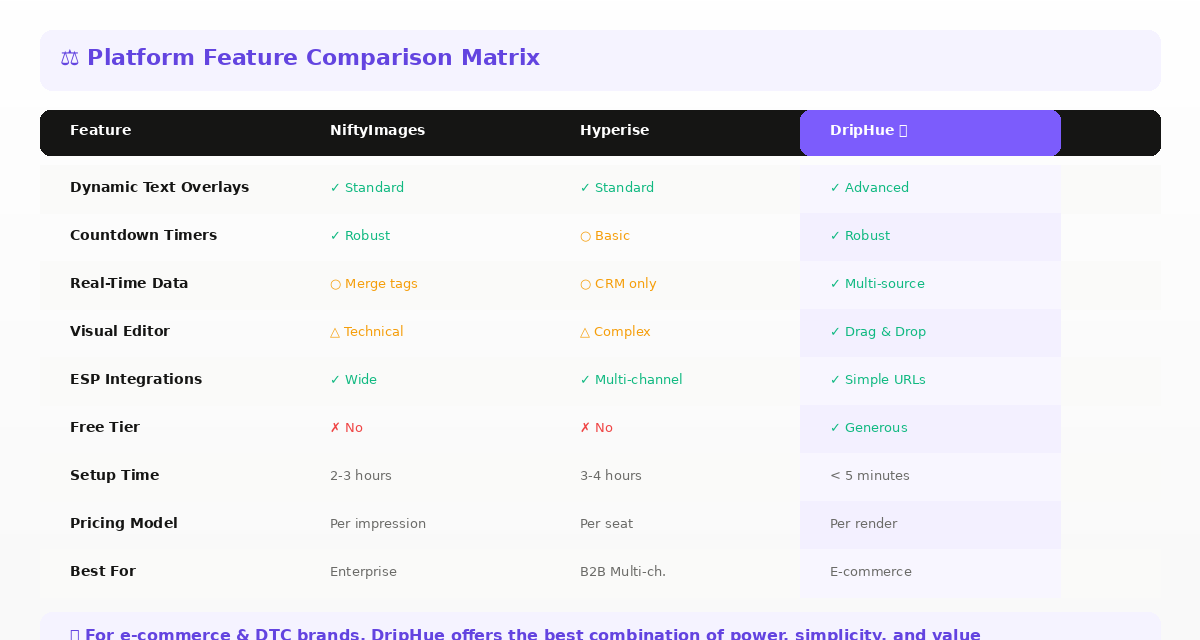
All three platforms support dynamic text overlays — the core name personalisation capability — though Driphue’s Canva-based rendering preserves the most design fidelity. NiftyImages has the most mature rule-based conditional image display. Hyperise has the strongest multi-channel coverage. Driphue has the deepest e-commerce ESP integration documentation and the only native Canva import workflow.
On accessibility and mobile rendering, all three platforms deliver standard image formats compatible with major email clients. For best practices specific to personalised images, see our guides to email accessibility and mobile rendering optimisation.
Pricing Comparison
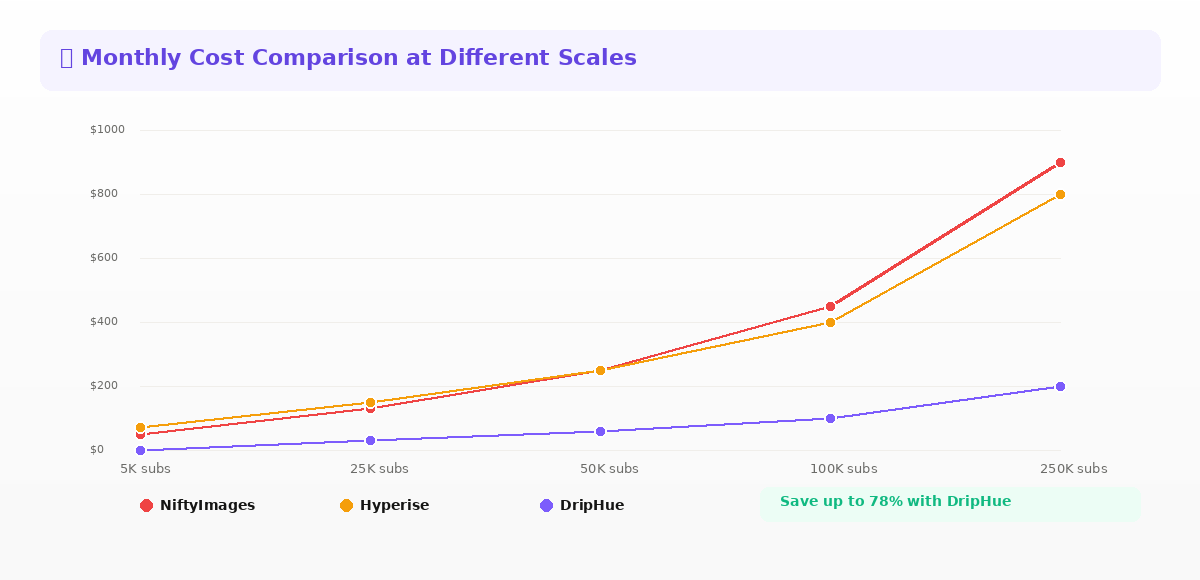
Pricing models differ significantly across the three platforms. NiftyImages uses impression-based pricing that can become expensive at high volume. Hyperise charges per user seat with tiered feature access, bundling email, website, and video personalisation together. Driphue offers view-based pricing with all core features included across every plan — no feature gating, no unused channel costs.
For a mid-size e-commerce brand sending to 50,000 subscribers, Driphue typically offers the most competitive pricing for email-only personalisation use cases. Hyperise may offer comparable total cost of ownership for brands that genuinely use the multi-channel features. NiftyImages can be competitive at lower volumes but scales steeply at high impression counts. For the full pricing breakdown, see Driphue’s pricing page.
ESP Integration Depth
All three platforms work with major ESPs through image URL embedding — the standard mechanism for dynamic email images. The difference is in integration depth and documentation quality.
NiftyImages provides integration guidance for popular ESPs and has been tested with most major platforms over its years in the market. Hyperise offers broader multi-channel integrations beyond email, including CRM and LinkedIn. Driphue provides the most e-commerce-specific integration documentation, with dedicated guides for every major platform’s exact merge tag syntax and platform-specific notes for Klaviyo flows, Omnisend automations, and Shopify-connected programmes.
Ease of Implementation
Implementation speed matters, particularly for smaller teams without dedicated technical resources. Driphue is the fastest to implement for teams already in Canva — design in Canva, import, configure parameters, copy URL, paste into ESP. Most users are live in under 30 minutes. NiftyImages requires more technical setup but offers more conditional logic once configured. Hyperise’s multi-channel setup is the most complex, particularly for first-time CRM data connections.
Which Platform Is Right for You?
If you need a mature platform with advanced rule-based dynamic imagery and have dedicated email development resources, NiftyImages is a solid, proven choice. If you need personalisation across email, web, and ads with a B2B or multi-channel focus, Hyperise offers the broadest platform coverage. If you are an e-commerce or DTC brand that designs in Canva, runs email marketing on Klaviyo or a comparable ESP, and wants the fastest path from zero to personalised email images, Driphue is built specifically for you.
For practical implementation strategy regardless of platform, see our email personalisation strategies guide and our 90-day implementation roadmap. The best way to evaluate any platform is to try it — start your free Driphue trial and test personalised image campaigns with your actual audience before committing.
Keep reading
More from the blog
 Industry Trends
Email Personalization for Arts and Crafts Brands: Inspiring Makers One Inbox at a Time
9 min read Industry Trends
Email Personalization for Baby and Kids Brands: Growing Families, Growing Revenue
9 min read Industry Trends
Email Personalization for Education and Online Course Brands: Enrollment to Completion
9 min read
Personalise every image in your emails
Turn your Klaviyo, Brevo or any-ESP campaigns into dynamic, per-subscriber images and countdown timers — no code required.