Hyperise vs Driphue: Choosing the Best Email Personalization Platform for E-Commerce
Comparing Email Image Personalisation Platforms
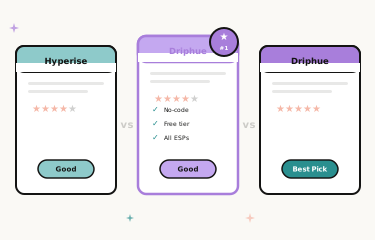
Hyperise and Driphue both help brands add personalised images to email marketing. But each platform has a fundamentally different focus, feature set, and intended customer. Hyperise is a multi-channel personalisation platform built for sales teams and agencies that need personalisation across email, websites, and outbound channels. Driphue is a purpose-built e-commerce email image personalisation tool designed specifically for online retail brands whose primary revenue channel is email.
Understanding these differences clearly helps you choose the right tool for your specific use case — and avoid paying for features you will never use. This comparison covers platform focus, template design, e-commerce campaign support, ESP integrations, pricing, and the specific scenarios where each platform is the stronger choice.
Platform Focus and Positioning
Hyperise
Hyperise positions itself as a broad personalisation platform covering email, websites, landing pages, and social outreach. The platform serves sales teams, agencies, and marketers across B2B and B2C contexts — anyone who wants to add a name or company logo to an image across multiple touchpoints. This breadth is the platform’s core value proposition for multi-channel users, but it means features are distributed across multiple use cases rather than deeply optimised for any single one.
Driphue
Driphue is built exclusively for e-commerce email image personalisation. Every feature — the Canva design import, the ESP integrations, the parameter configuration system — is designed specifically for online retail email marketing. This focused approach delivers deeper e-commerce functionality and a significantly simpler implementation path for brands whose personalisation need begins and ends with email. For the complete overview of what email image personalisation is and how it works, see our complete guide to email image personalisation for e-commerce.
Template Design and Workflow
Hyperise
Hyperise provides a proprietary image editor supporting image layers, text overlays, and basic design customisation. The editor handles common personalisation scenarios including name insertion and company logo placement, with particular strength in B2B sales outreach templates. Teams that want to use Hyperise must design within its editor — there is no native import from Canva or other design tools.
Driphue
Driphue’s core design workflow is Canva-native. You design your email images in Canva using your brand’s full design system — fonts, colours, imagery, layouts — and import directly into Driphue via the Canva integration. For the majority of e-commerce marketing teams who already work in Canva, this eliminates the need to learn a second editor and maintain designs in two places. Design updates are made in Canva and re-imported; there is no parallel design system to manage.
Driphue’s template rendering prioritises design quality for consumer-facing e-commerce emails. Advanced typography handling, responsive text scaling, and precise text positioning ensure personalised names render correctly across the full range of subscriber name lengths — whether the name is three characters or fifteen — without breaking the visual layout.
E-Commerce Campaign Support
Hyperise
Hyperise supports standard email personalisation use cases. The platform can generate personalised images for email campaigns, though its template library and workflow tooling reflect its multi-channel positioning rather than deep specialisation in specific e-commerce email campaign types. There are no purpose-built flows for cart recovery, welcome series, or post-purchase sequences.
Driphue
Driphue provides specialised support for the core e-commerce email campaign types where personalised images drive the most revenue. Every major e-commerce flow has dedicated documentation and template patterns: cart abandonment recovery, welcome series, flash sales and promotional campaigns, birthday and anniversary campaigns, and post-purchase sequences. Each campaign type is documented with ESP-specific implementation guidance.
ESP Integrations
Hyperise
Hyperise integrates with email platforms and CRM tools through its API and direct integrations, supporting personalisation across email, web, and outreach channels. Integration depth reflects the multi-channel scope — it works with many platforms at a functional level rather than with deep e-commerce-specific documentation for each.
Driphue
Driphue provides documented, step-by-step integration guides for every major e-commerce ESP, each with the correct merge tag syntax for that specific platform. Available guides include Klaviyo, Mailchimp, Omnisend, ActiveCampaign, HubSpot, GetResponse, ConvertKit, AWeber, and more. The Klaviyo integration is particularly deep, covering every major Klaviyo flow type with specific implementation guidance for e-commerce workflows.
Pricing Comparison
Hyperise
Hyperise uses subscription tiers based on features and impressions. The platform’s pricing reflects its multi-channel scope — email, website, and outreach personalisation are bundled together. For brands that need all three channels, this bundling provides value. For brands that only need email image personalisation, they are paying for website and outreach features they will not use.
Driphue
Driphue’s pricing is based on image views with clear, transparent tiers — you pay for what you actually use. There are no unused channel costs bundled in. For e-commerce brands with large subscriber lists and high email send volumes, the view-based model produces a predictable and typically lower cost structure than a multi-channel subscription at equivalent scale.
When to Choose Hyperise
Hyperise is the stronger choice in several specific scenarios. If your personalisation need genuinely spans email, website, and sales outreach channels and you want a single platform managing all three, Hyperise’s multi-channel architecture has clear value. If your primary use case is B2B outbound sales personalisation — personalised images in cold email sequences, LinkedIn outreach, or account-based marketing landing pages — Hyperise’s positioning and template library are well suited to that workflow. And if you need personalised website images alongside personalised email images, Hyperise covers both where Driphue does not.
When to Choose Driphue
Driphue is the stronger choice for e-commerce brands focused on email marketing revenue. If email is your primary channel and Klaviyo, Omnisend, or another e-commerce ESP is your platform, Driphue’s focused integration depth and Canva-native workflow make it significantly faster to implement and easier to manage. If design quality matters — if your email images need to look as polished as your other brand assets — Driphue’s Canva workflow preserves your full design system without compromise. And if you want purpose-built support for the specific campaign types that drive e-commerce email revenue, Driphue’s documentation and template patterns are built around exactly those flows.
The Canva Workflow Advantage in Practice
For most e-commerce marketing teams, the Canva workflow difference is the single most practically significant distinction between the two platforms. Consider the typical e-commerce email workflow: a designer creates campaign imagery in Canva, exports it, and a marketer uploads it to the ESP. With Driphue, the same Canva file becomes the source of the personalised image — no new editor to learn, no separate design system to maintain, no friction between the design workflow and the personalisation layer.
When a campaign needs a design update, the designer updates the Canva file and re-imports. Every personalised image URL automatically reflects the updated design. This workflow advantage compounds over time: the longer a team uses Driphue, the more Canva-native assets it has, and the lower the ongoing maintenance cost of personalisation at scale.
Bottom Line
Hyperise and Driphue solve related but different problems. Hyperise offers breadth across channels; Driphue offers depth in e-commerce email. For online retail brands where email is a primary revenue driver, Driphue’s focused approach delivers more relevant features, better design workflow integration, and deeper ESP-specific implementation support.
For a three-way comparison that adds NiftyImages to the evaluation, see our NiftyImages vs Hyperise vs Driphue comparison. For the full Driphue feature and use case overview, see our complete guide to email image personalisation for e-commerce.
Keep reading
More from the blog
 Marketing Strategy
Birthday and Anniversary Email Campaigns: Personalized Images That Drive Repeat Purchases
9 min read Marketing Strategy
Black Friday Email Marketing with Personalized Images and Countdown Timers
10 min read Marketing Strategy
Dynamic Countdown Timers in Emails: How to Create Urgency That Actually Converts
6 min read
Personalise every image in your emails
Turn your Klaviyo, Brevo or any-ESP campaigns into dynamic, per-subscriber images and countdown timers — no code required.