Movable Ink Pricing & Alternatives for Mid-Market E-commerce Brands
What Is Movable Ink?
Movable Ink is the enterprise leader in real-time email content personalisation. Founded in 2010, it has built a comprehensive platform that goes far beyond simple image personalisation — AI-driven content selection, behavioural targeting, product recommendations, and deep integrations with enterprise CDPs and data warehouses. For brands running seven-figure email marketing budgets with dedicated MarTech teams, Movable Ink delivers genuine capability that few platforms match.
But Movable Ink is built for enterprises with the budget, headcount, and technical infrastructure to match. For mid-market e-commerce brands — those doing between $2M and $50M in annual revenue, running lean marketing teams, and making pragmatic decisions about tool spend — the Movable Ink proposition raises a fundamental question: how much of that capability do you actually need, and what are you paying for the parts you don’t? For the broader context on email image personalisation tools, see our full tools comparison.
Movable Ink Pricing: What to Expect
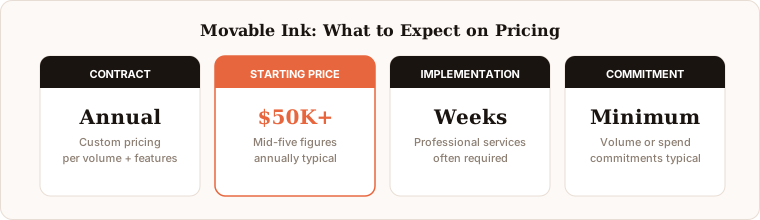
Movable Ink does not publish its pricing publicly — standard practice for enterprise SaaS, but frustrating for mid-market brands trying to make a fair comparison. Based on industry reports, community discussions, and feedback from marketers who have gone through the Movable Ink evaluation process, here is what brands typically encounter.
Contract structure: Annual contracts with custom pricing based on email volume, feature tier, and integration complexity. There is no self-serve or month-to-month option — every engagement starts with a sales conversation and a scoped proposal.
Starting range: Pricing typically begins in the mid-five figures annually. Brands sending tens of millions of emails per month, or requiring advanced AI features and CDP integrations, report significantly higher costs. A realistic budget for a mid-market brand evaluating Movable Ink starts at $30–60k per year for a baseline implementation.
Implementation costs: Beyond the platform licence, Movable Ink implementations frequently require professional services for initial setup, template creation, data integration, and ongoing optimisation. These services costs are separate from and additive to the platform fee, and can be substantial — particularly for integrations with custom data sources or legacy ESP configurations.
Minimum commitments: Most Movable Ink contracts include minimum volume or spend commitments that lock in the relationship for the contract term. Exiting before the term ends is typically costly.
Why Mid-Market Brands Seek Alternatives
The gap between Movable Ink’s capabilities and mid-market operational realities creates predictable friction at three levels.
Budget mismatch. A growing e-commerce brand doing $5–50M in revenue may generate $200–500k annually from email as a channel. Allocating $30–60k — or more — of that to a single personalisation tool is a very large portion of the channel’s tooling budget. Brands at this stage typically need to choose between Movable Ink and other strategic investments: additional headcount, Klaviyo features, paid acquisition, or creative production.
Complexity overhead. Movable Ink’s power comes with operational complexity. The platform requires trained users, ongoing campaign management, and often dedicated MarTech support. Marketing teams of two to five people — common at this revenue tier — typically cannot absorb the management overhead without diverting capacity from other priorities.
Feature overkill. The use cases that drive the largest revenue impact for most e-commerce brands — personalised welcome images with subscriber names, cart recovery images with specific offer expiry dates, loyalty tier and points-balance displays, birthday and anniversary personalisation — do not require AI-driven content selection, real-time inventory feeds, or multi-touchpoint behavioural targeting. These are valuable enterprise features that mid-market brands pay for without material benefit.
Driphue: The Accessible Alternative
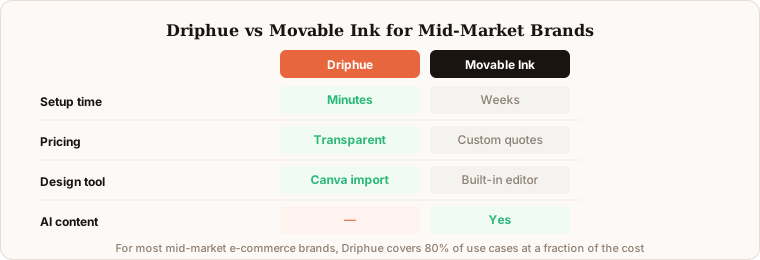
Driphue is purpose-built for the use cases that matter most to e-commerce brands: personalised email images using subscriber data from your ESP, designed in tools your team already uses, deployable in minutes rather than weeks. Here is how it compares across the dimensions that mid-market brands care about most.
Design workflow: Movable Ink has a powerful but complex proprietary editor. Driphue lets you import designs from Canva — a tool your team already uses, with a design library you have already built. No new design tool to learn, no proprietary template format to manage.
Setup time: Movable Ink implementations typically take weeks to months, including scoping, professional services engagement, and integration work. Driphue setup from account creation to first live personalised image takes under an hour in most cases.
Pricing: Driphue offers transparent, view-based pricing with a free tier for getting started. No annual contracts, no implementation fees, no minimum commitments. Paid plans start at $19 per month — a fraction of the Movable Ink baseline.
ESP integration: Both tools work with major ESPs. Driphue has focused, documented integrations with Klaviyo, Mailchimp, HubSpot, and 20+ platforms, with ESP-specific guides that walk through the exact steps for each platform.
Personalisation capabilities: Movable Ink offers more sophisticated rule-based logic, AI-driven content selection, and real-time data feeds. Driphue focuses on merge tag-based personalisation, which covers the vast majority of e-commerce use cases: welcome emails, cart recovery, loyalty displays, and post-purchase follow-ups. For brands that need the enterprise capabilities, Movable Ink is the right tool. For brands that need the high-impact use cases without the enterprise overhead, Driphue is the right tool.
Other Alternatives to Consider
NiftyImages sits between Driphue and Movable Ink in terms of feature breadth. It offers a broader feature set including countdown timers and some interactive elements, with impression-based pricing that scales with volume. A reasonable middle-ground option for brands that need features beyond merge tag personalisation but are not ready for enterprise pricing. See our NiftyImages comparison for a detailed breakdown.
Hyperise takes a multi-channel approach to personalisation — covering email, web, and video in a unified platform. Positioned differently from Movable Ink but offers some overlapping capabilities, particularly for brands running personalisation across multiple touchpoints simultaneously. See our Hyperise comparison.
Litmus Personalize (formerly Kickdynamic) offers open-time personalisation capabilities bundled with the Litmus email testing and analytics suite. A viable option for brands already investing in Litmus who want to consolidate personalisation and testing under one vendor relationship.
When Movable Ink Is the Right Choice
Movable Ink remains the best option in a specific set of circumstances: your annual email marketing budget is large enough to absorb the platform and services costs without material trade-offs; you need AI-driven content selection, real-time inventory feeds, or behavioural targeting across touchpoints; your email programme is sophisticated enough — in both volume and automation depth — to leverage advanced rule-based logic; and you have dedicated MarTech or email operations staff to manage the platform ongoing.
If those conditions are met, Movable Ink delivers capabilities that genuinely justify the investment. If they are not, you are paying enterprise prices for features you will not use and complexity you cannot manage.
Making the Right Decision for Your Stage
The honest framing for mid-market brands is this: the revenue impact of personalised email images comes primarily from the use cases that Driphue handles — subscriber name personalisation in welcome and campaign images, cart recovery with specific offer expiry dates, loyalty tier and points displays, birthday and anniversary personalisation. These use cases are responsible for the 30–60% revenue lifts that brands consistently report when deploying personalised imagery.
Movable Ink adds sophisticated capability on top of this foundation — real-time product feeds, AI-driven selection, behavioural triggers across channels. That incremental capability has real value at scale. For most mid-market brands, however, the incremental value does not yet justify the incremental cost. Start with the high-impact fundamentals, build the revenue compounding, and revisit enterprise tooling when the programme scale justifies it.
For the complete personalisation strategy, see our email personalisation guide. For a full competitive landscape overview, see our tools comparison. Start your free Driphue trial and deliver the high-impact use cases from day one.
Keep reading
More from the blog
 Email Personalization
The E-commerce Guide to Email Image Personalisation: From First Image to Full Automation
11 min read Email Personalization
Email Image Personalisation Tools Compared: Driphue vs NiftyImages vs Hyperise vs OKZest
10 min read Email Personalization
Email Image Personalization: The Complete Guide for E-Commerce Brands in 2026
8 min read
Personalise every image in your emails
Turn your Klaviyo, Brevo or any-ESP campaigns into dynamic, per-subscriber images and countdown timers — no code required.