What Is Open-Time Email Content?
Open-time email content refers to any element in an email that is fetched or rendered at the moment a subscriber opens it, rather than when the email was sent. The concept is appealing: instead of locking content at send time, the email pulls fresh data every time someone opens it.
In practice, open-time content most commonly appears as dynamic images, live countdown timers, weather widgets, live polls, inventory counters, and map-based location elements.
The terminology varies by vendor. Litmus uses "real-time email," Movable Ink favours "moment-of-open," and most ESPs simply call it "dynamic content." For a full breakdown of these naming conventions, see our complete guide to email image personalisation.
How Open-Time Rendering Actually Works
When an email is delivered, it sits in the subscriber inbox as HTML. That HTML contains image tags pointing to external URLs. Here is the critical distinction:
Send-time personalisation: Your ESP replaces merge tags with actual data before the email is sent. The image URL is fully resolved with subscriber-specific parameters. When the image server receives a request, it renders the personalised image using data already embedded in the URL.
True open-time rendering: The image URL makes a fresh server request at the moment of open. The server can look up live data like current inventory, real-time pricing, or weather at the subscriber location and return an image reflecting that instant.
Both approaches produce personalised images, but they differ in what data can change between sends and opens. Send-time personalisation locks the data at delivery. Open-time rendering can refresh it.
What Open-Time Email Content Cannot Do in 2026
This is where most marketing content about open-time email gets dishonest. Two major technical constraints limit what is actually possible:
Apple Mail Privacy Protection (MPP): Apple Mail pre-fetches email content through proxy servers when the email arrives, not when the subscriber actually opens it. This means the "moment of open" for Apple Mail users is actually the moment of delivery. Any content designed to be fresh at open time is instead frozen at delivery time for roughly 50-60% of email opens. Our MPP deep dive covers this in detail.
Gmail image caching: Gmail routes images through its own proxy and caches them. Subsequent opens may show the cached version rather than a fresh render. This means content that was supposed to update between opens may appear stale.
Together, Apple Mail and Gmail account for the majority of email opens. Any vendor claiming flawless open-time rendering across all clients is either uninformed or misleading.
What Actually Works Reliably
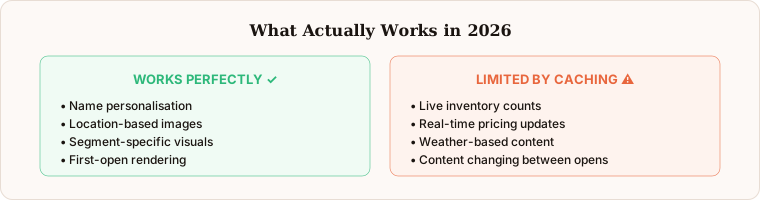
Despite these constraints, personalised email images are far from broken. You just need to design for how things actually work rather than how marketing copy says they should work.
Name and data personalisation works perfectly. When subscriber data is baked into the image URL at send time, every open shows the correct personalisation. Sarah always sees Sarah. Each unique URL is cached separately, so caching actually helps rather than hurts.
Welcome images, cart recovery visuals, and loyalty displays all work flawlessly because the personalisation data does not need to change after send time. Your subscriber name, the product they abandoned, their points balance are all known at send time and render perfectly.
First-open freshness is real. Even with caching, the first render is always fresh. For most e-commerce use cases, the first open is where the conversion happens.
Segment-based imagery: Showing different visuals to different segments (VIP vs standard, different product categories) works because each segment generates a unique URL.
The Honest Approach: Design for Send-Time, Benefit from Open-Time
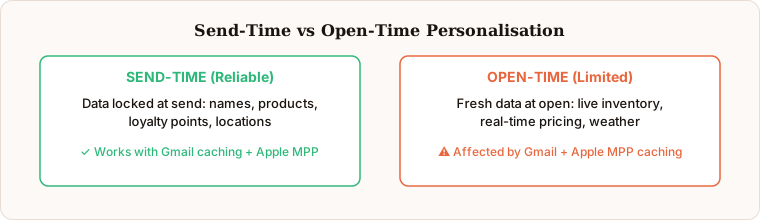
The most reliable strategy is to design your personalised images around send-time data while accepting open-time freshness as a bonus rather than a guarantee.
This is exactly how Driphue works. You design in Canva, add merge tag layers in Driphue, and the personalised image URL embeds subscriber data from your ESP. The result: every subscriber sees a perfectly personalised image regardless of their email client, caching behaviour, or privacy settings.
Driphue works with all major ESPs including Klaviyo, Mailchimp, HubSpot, ActiveCampaign, and 20+ more. The image URLs are generated with the correct merge tag syntax for whichever ESP you use.
If you are evaluating open-time content tools, ask the vendor how their solution handles MPP and Gmail caching. If they cannot give you a clear, honest answer, that tells you something. If you want to see how tools compare on features and transparency, our email personalisation tools comparison breaks it down.
Keep reading
More from the blog
 Email Personalization
The E-commerce Guide to Email Image Personalisation: From First Image to Full Automation
11 min read Email Personalization
Email Image Personalisation Tools Compared: Driphue vs NiftyImages vs Hyperise vs OKZest
10 min read Email Personalization
Email Image Personalization: The Complete Guide for E-Commerce Brands in 2026
8 min read
Personalise every image in your emails
Turn your Klaviyo, Brevo or any-ESP campaigns into dynamic, per-subscriber images and countdown timers — no code required.