Zero-Party Data Collection Strategies for Better Email Image Personalization

What Is Zero-Party Data and Why It Matters
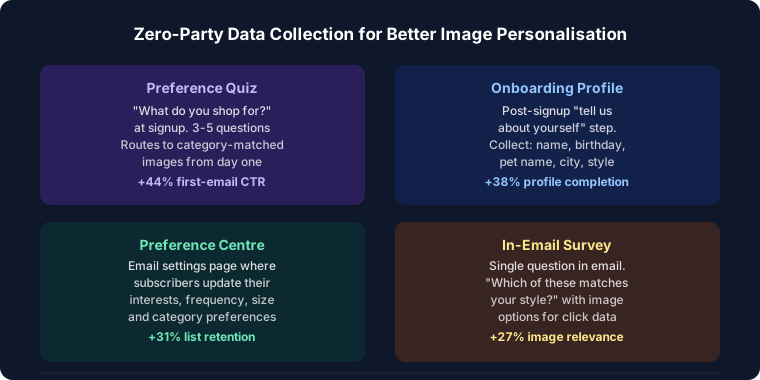
Zero-party data is information that customers intentionally and proactively share with your brand. Unlike first-party behavioural data — browsing history, purchase records, click patterns — zero-party data comes directly from explicit customer input: quiz responses, preference selections, survey answers, and profile updates. It represents the highest-quality personalisation data available because the customer told you exactly what they want, rather than you inferring it from their actions.
For email image personalisation, zero-party data unlocks experiences that feel genuinely curated rather than algorithmically inferred. When a subscriber tells you they prefer minimalist design, you can deliver personalised images that reflect that aesthetic. When they indicate they are shopping for a wedding, you can personalise around that specific life event with imagery that speaks directly to their current context. When they share that they are a beginner rather than an expert, you can tailor the product recommendations and messaging tone in the image accordingly.
This guide covers the most effective zero-party data collection methods, how to turn collected preferences into personalised imagery, how to combine zero-party with first-party data, and real results from brands that have built preference-driven personalisation programmes.
Zero-Party Data Collection Methods
Onboarding Quizzes
The most effective zero-party data collection happens at or shortly after signup. An onboarding quiz — framed as "Help us personalise your experience" rather than "Fill in this form" — collects the preferences that power personalisation from the subscriber's very first email. The framing matters: subscribers are far more willing to share preferences when the immediate benefit (more relevant emails) is made explicit in the invitation.
Keep quizzes to three to five questions maximum to maintain completion rates. The questions that produce the most useful personalisation data for email imagery are: product category interest (which product areas are most relevant to the subscriber), style or preference type (minimalist vs bold, functional vs fashion-forward, etc.), shopping occasion or use context (everyday, gifting, special occasions), and one or two brand-specific questions that reflect your product range's natural divisions.
Your personalised welcome series is the natural home for a quiz invitation. A personalised "Sarah, help us get to know you" hero image with a clear CTA to the quiz creates both a personal first impression and a data collection opportunity in the same send.
Preference Centres
Give subscribers ongoing control over their experience through a preference centre accessible from every email footer. Let them update product category interests, communication frequency, and content type preferences at any time. Each preference selection powers more relevant personalised images in future emails, and the act of offering control builds trust with privacy-conscious subscribers.
Preference centres serve two functions simultaneously: they reduce unsubscribes by letting subscribers dial back frequency rather than opting out entirely, and they generate updated zero-party data that improves personalisation accuracy over time. A subscriber who changed their product interest from "fitness" to "outdoor" six months after joining is telling you something important that behavioural data alone might not capture for weeks.
Interactive Email Content
Embed simple choice interactions directly in emails: "Sarah, which style is more you?" with two or three clickable image options routes subscribers to different content experiences and simultaneously records a preference data point. Each click captures an explicit preference while engaging the subscriber in a way that feels participatory rather than extractive.
Interactive preference captures are most effective when the choice is genuinely interesting to the subscriber — two different aesthetic directions, two different product approaches, two different gifting contexts. The images presented as choices should be visually compelling enough that the subscriber actively wants to pick their preference rather than feeling like they are completing a form.
Post-Purchase Surveys
After a purchase, subscribers are at peak brand engagement and most willing to share information. Brief post-purchase survey questions — "who was this gift for?", "what's your next goal?", "what brought you to us?" — capture data that reveals intent and context rather than just behaviour. A subscriber who says "this was a gift for a friend" reveals gifting behaviour that informs future personalisation. One who says "I'm training for my first marathon" reveals a motivation that can drive a months-long personalised journey.
Progressive Profiling
Do not try to collect all zero-party data at once. Add one or two new data collection touchpoints per month — a quiz in the welcome series, a preference question in month two, a survey after the second purchase. Over time, you build rich zero-party profiles without overwhelming any individual subscriber with long forms. Progressive profiling also ensures your data stays current: a preference collected 18 months ago may no longer be accurate, while one collected last month almost certainly is.
Turning Zero-Party Data into Personalised Images
Visual Style Personalisation
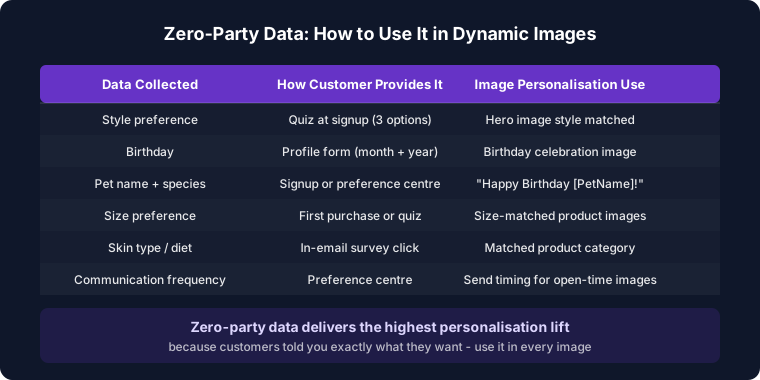
Subscribers who selected "minimalist" in a style preference quiz see clean, restrained personalised images with ample white space and understated typography. Those who chose "bold and colourful" see vibrant, energetic designs. The visual style of the image itself becomes personalised, not just the text overlay — creating a fundamentally different aesthetic experience for different subscriber segments while maintaining consistent brand identity across all variants.
In Driphue, create multiple template variants for a single campaign layout: the same structural design with different visual treatments — background colour, typography weight, imagery style — mapped to each preference segment. Your ESP's conditional content logic routes each subscriber to the appropriate template variant based on their stored preference.
Life Event Personalisation
Wedding planning, new baby, home renovation, starting a fitness journey, preparing for a new season — life events drive purchasing decisions with a specificity that generic product recommendations cannot match. "Sarah, getting wedding-ready" with curated bridal-context imagery creates an experience that feels designed for exactly where Sarah is right now, not for a hypothetical average customer.
Life event data has a natural expiry: the wedding eventually happens, the baby arrives, the fitness goal is achieved or abandoned. Build event timelines into your personalisation logic so that wedding-context imagery phases out after the stated wedding date and transitions to post-event personalisation ("Sarah, your first year together") rather than continuing indefinitely.
Category and Interest Personalisation
When a subscriber explicitly tells you their product interests through a quiz, personalise images around those stated categories with higher confidence than you would infer from browsing behaviour. Browse behaviour reflects curiosity; stated preferences reflect genuine intent. A subscriber who browsed five categories but explicitly said "I'm most interested in skincare" should receive skincare-led imagery even if their browse behaviour is more diffuse.
Communication Preference Matching
Some subscribers want deal-focused communications, others want inspiration and discovery, some want educational content. Match personalised image style and messaging tone to each subscriber's stated communication preferences: deal-oriented subscribers see offer-forward imagery with clear pricing and discount information; inspiration-seekers see lifestyle and editorial-style imagery with softer commercial messaging.
Combining Zero-Party with First-Party Data
The most powerful personalisation programmes combine zero-party stated preferences with first-party behavioural data. Stated preferences provide the broad personalisation direction: which product categories, which aesthetic style, which communication tone. Behavioural data refines the specific recommendations within that direction: which products within the preferred category, which specific items are most relevant given recent browse behaviour, which moment in the purchase journey the subscriber is currently at.
When zero-party and first-party data conflict — a subscriber said they prefer minimalism but have been extensively browsing bold product ranges — behavioural data typically reflects current intent more accurately than older stated preferences. Build recency weighting into your personalisation logic so that recent behaviour can override older preference data when the two diverge. For the full segmentation framework, see our email segmentation guide.
Privacy Advantage of Zero-Party Data
Zero-party data is the most privacy-friendly personalisation approach because customers explicitly chose to share it. There is no inference, no tracking, no third-party data purchase — just a subscriber telling you what they want and receiving personalised experiences in return. This aligns perfectly with GDPR and privacy regulations that emphasise consent and transparency. Subscribers who shared preferences expect and welcome the resulting personalisation, making zero-party data-driven emails the least likely personalisation type to generate complaint or unsubscribe responses.
Real Results from Zero-Party Data Personalisation
Beauty brand — 56% higher email revenue: Subscribers who completed a skin type and concern quiz and received quiz-matched personalised images — with imagery and product copy tailored to their specific skin profile — generated 56% more email revenue than non-quiz subscribers receiving standard personalised imagery with name only.
Fashion retailer — 3.4x style quiz conversion rate: Subscribers who completed a three-question style preference quiz and received style-matched personalised imagery converted at 3.4 times the rate of subscribers receiving generic promotional imagery, with the lift concentrated in subscribers whose stated preferences differed significantly from the brand's default campaign aesthetic.
Start Collecting Zero-Party Data
Zero-party data creates personalisation that feels like a personal shopper rather than a tracking algorithm — because it is. The subscriber told you what they want; you are simply delivering it. Start with a three-question onboarding quiz in your welcome series, route quiz responses to matching Driphue templates, and measure the revenue difference between quiz-completed and non-quiz subscribers over your first 60 days.
For the complete personalisation strategy, see our email personalisation guide. For how zero-party data complements behavioural signals, see our first-party data guide. Start your free Driphue trial and deliver preference-driven personalised email images today.
Keep reading
More from the blog
 Marketing Strategy
Birthday and Anniversary Email Campaigns: Personalized Images That Drive Repeat Purchases
9 min read Marketing Strategy
Black Friday Email Marketing with Personalized Images and Countdown Timers
10 min read Marketing Strategy
Dynamic Countdown Timers in Emails: How to Create Urgency That Actually Converts
6 min read
Personalise every image in your emails
Turn your Klaviyo, Brevo or any-ESP campaigns into dynamic, per-subscriber images and countdown timers — no code required.